





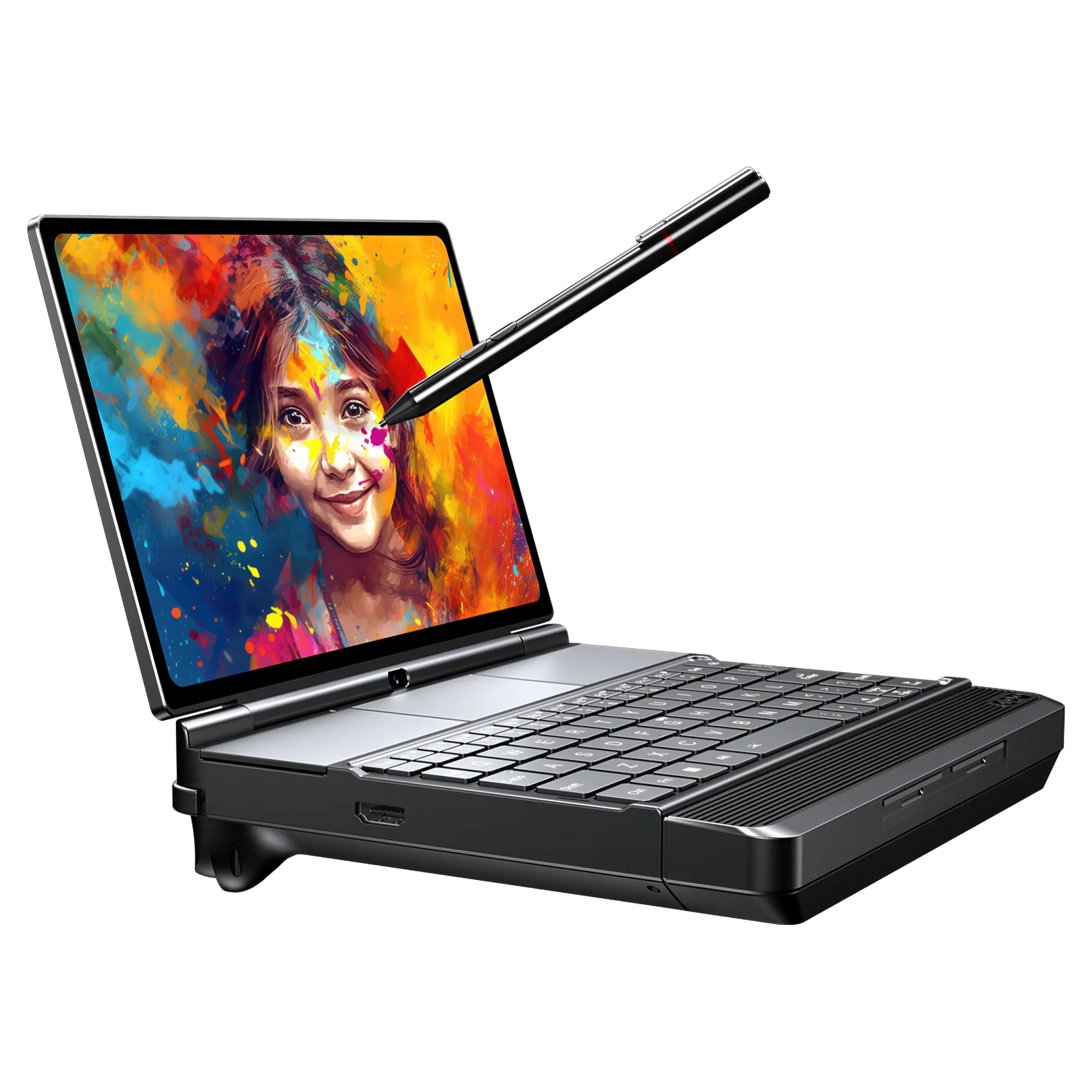
GPD Win Max 3 (Preorder)

Pre-order by 11 November 2026: We will order your configuration from GPD after the deadline. Delivery is planned for early December. Selected configurations only. Orders placed by 11 November will be ordered from GPD immediately afterwards. Delivery expected in 2026, subject to GPD; we will promptly inform you of delays.
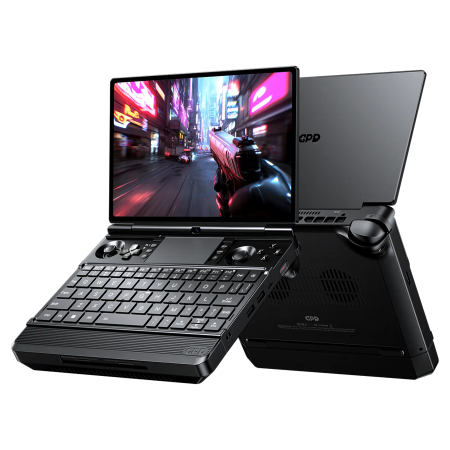
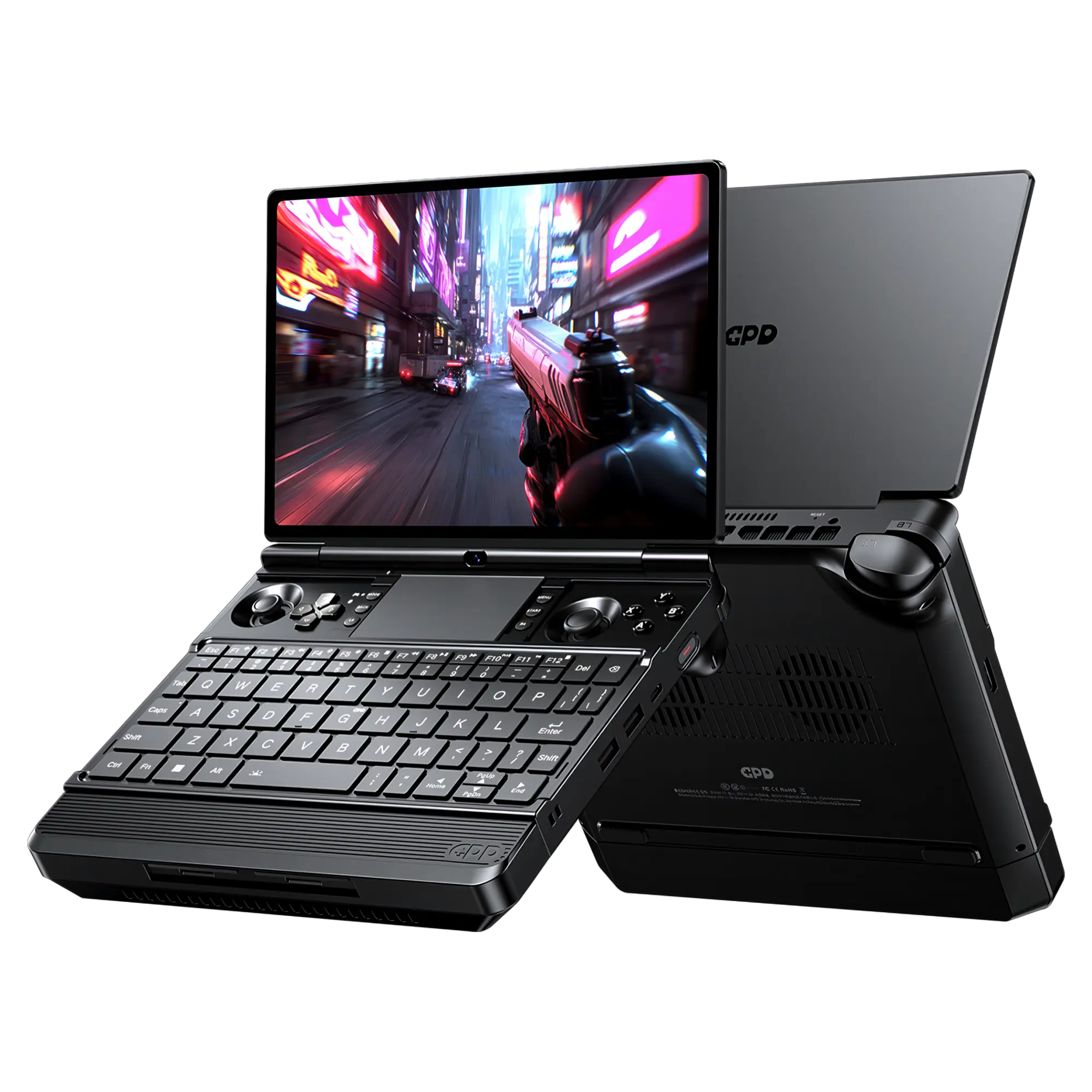
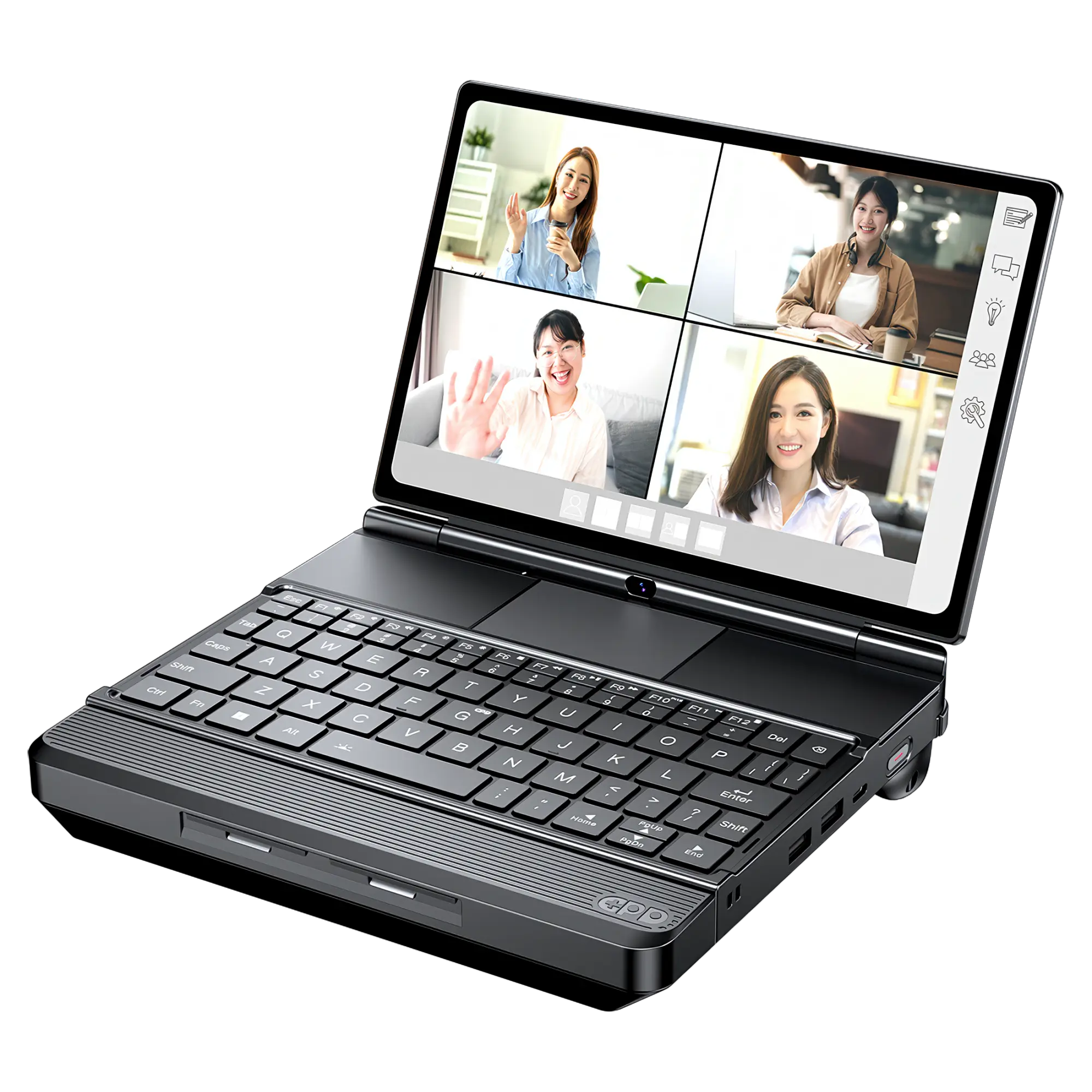
The GPD WIN Max 3 combines serious PC gaming, a vivid OLED screen and the versatility of a mini laptop.
- Gaming, productivity and creative work in one device
- Removable battery and optional extra cooling
- Built-in game controls, keyboard and touchpad
- QWERTY only, no German QWERTZ keyboard available
Pre-order until 11 November 2026
The GPD WIN Max 3 is a powerful piece of hardware, and stocking large quantities of such a premium device isn't exactly practical for a small specialist shop like ours. So we're collecting pre-orders until 11 November 2026 and will place our order with GPD based on the configurations you actually want. We offer selected configurations as part of this limited pre-order offer. All orders received by the deadline will be included in our order placed with GPD immediately afterwards. We expect delivery before the end of 2026; this depends on GPD. If there are any delays, we will inform you promptly.
Delivery is currently planned for early December 2026. Please keep in mind that this is an estimate, not a guaranteed delivery date.
Important keyboard information
The GPD WIN Max 3 is only available with an international QWERTY keyboard. Unfortunately, there will be no German QWERTZ version because the compact keyboard lacks the additional physical keys required for a full German layout. You can change the keyboard language in Windows, but that won't give you a complete physical German keyboard.
Desktop-class power in a compact laptop
The WIN Max 3 combines high-performance PC hardware with a compact laptop form factor and built-in gaming controls. Whether you're playing modern PC games, running emulators, programming, editing videos or experimenting with local AI models, this little machine is designed for demanding tasks.
Powered by AMD's Zen 5-based Strix Halo platform, the Ryzen AI Max+ 395 offers 16 cores and 32 threads with boost clocks up to 5.1 GHz. The Ryzen AI Max+ 388 comes with 8 cores and 16 threads, boosting up to 5.0 GHz. The 395 is especially useful for rendering, heavy multitasking and other CPU-intensive workloads.
Both models feature AMD Radeon 8060S graphics with 40 compute units and frequencies up to 2.9 GHz. This provides substantially more graphics power than conventional integrated laptop graphics, with support for DirectX 12 Ultimate, Vulkan 1.3 and OpenGL 4.6.
The platform supports configurable power profiles from 45W to 110W, depending on power supply, cooling and system configuration. Sustained high-power operation requires appropriate cooling and power delivery.
A spectacular OLED gaming display
The 9.06-inch AMOLED display delivers a 2400 × 1504 resolution, refresh rates up to 165Hz and HDR10 support. Fast games benefit from smooth motion, while OLED delivers deep blacks, strong contrast and vibrant colours.
The panel supports 10-bit colour, 105% DCI-P3 coverage according to GPD, and peak brightness up to 1050 nits in high-brightness mode. Corning Gorilla Glass 6 provides screen protection.
Multi-touch support lets you interact directly with Windows. Active styluses with up to 4096 pressure levels are also supported, with compatible pens available separately.
Compared to the WIN Max 2, the screen is slightly smaller, but you get a much more advanced AMOLED panel with a significantly higher refresh rate.
High-bandwidth memory for gaming and AI
Fast LPDDR5X memory running at 8000 MT/s in quad-channel mode provides the bandwidth needed by the processor and integrated graphics. CPU and GPU share the available memory, which can also be useful for memory-intensive AI workloads.
We offer three configurations: Ryzen AI Max+ 388 with 32GB RAM and a 1TB SSD, Ryzen AI Max+ 388 with 64GB RAM and a 2TB SSD, or Ryzen AI Max+ 395 with 128GB RAM and a 2TB SSD.
The 128GB configuration is particularly interesting for local language models, AI experimentation and other memory-heavy tasks. Depending on configuration and memory allocation, up to 96GB can be assigned as graphics memory. The platform also includes a dedicated NPU offering up to 50 TOPS of AI performance.
Fast storage and expansion options
The pre-installed NVMe SSD uses an M.2 2280 PCIe 4.0 ×4 slot. An additional M.2 2230 PCIe 4.0 ×2 slot is available for expanding your storage, making it easy to separate games, projects and larger data collections.
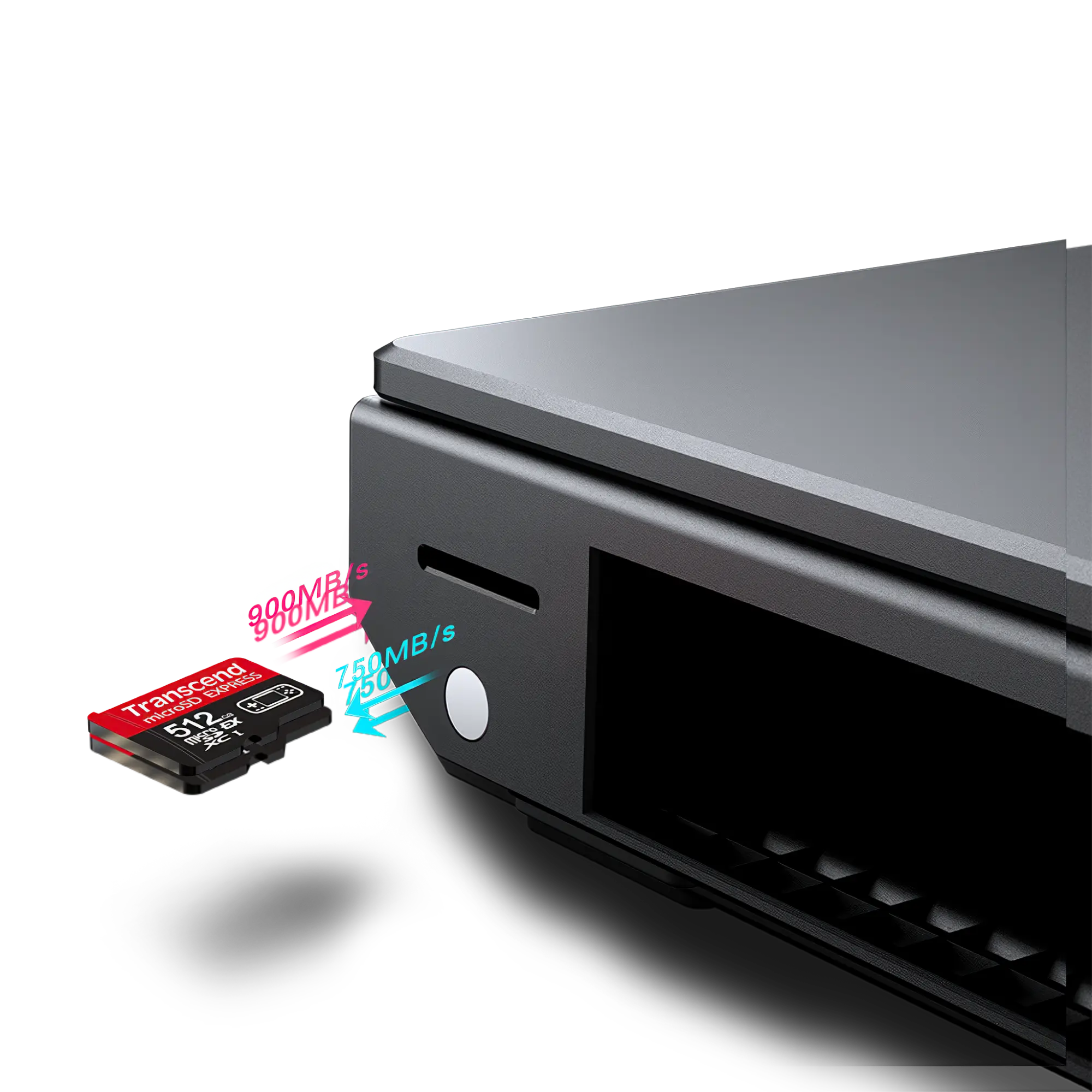
A microSD Express slot provides another option for fast compatible memory cards. Our configurations include either 1TB or 2TB of SSD storage.
Built-in controls for serious gaming
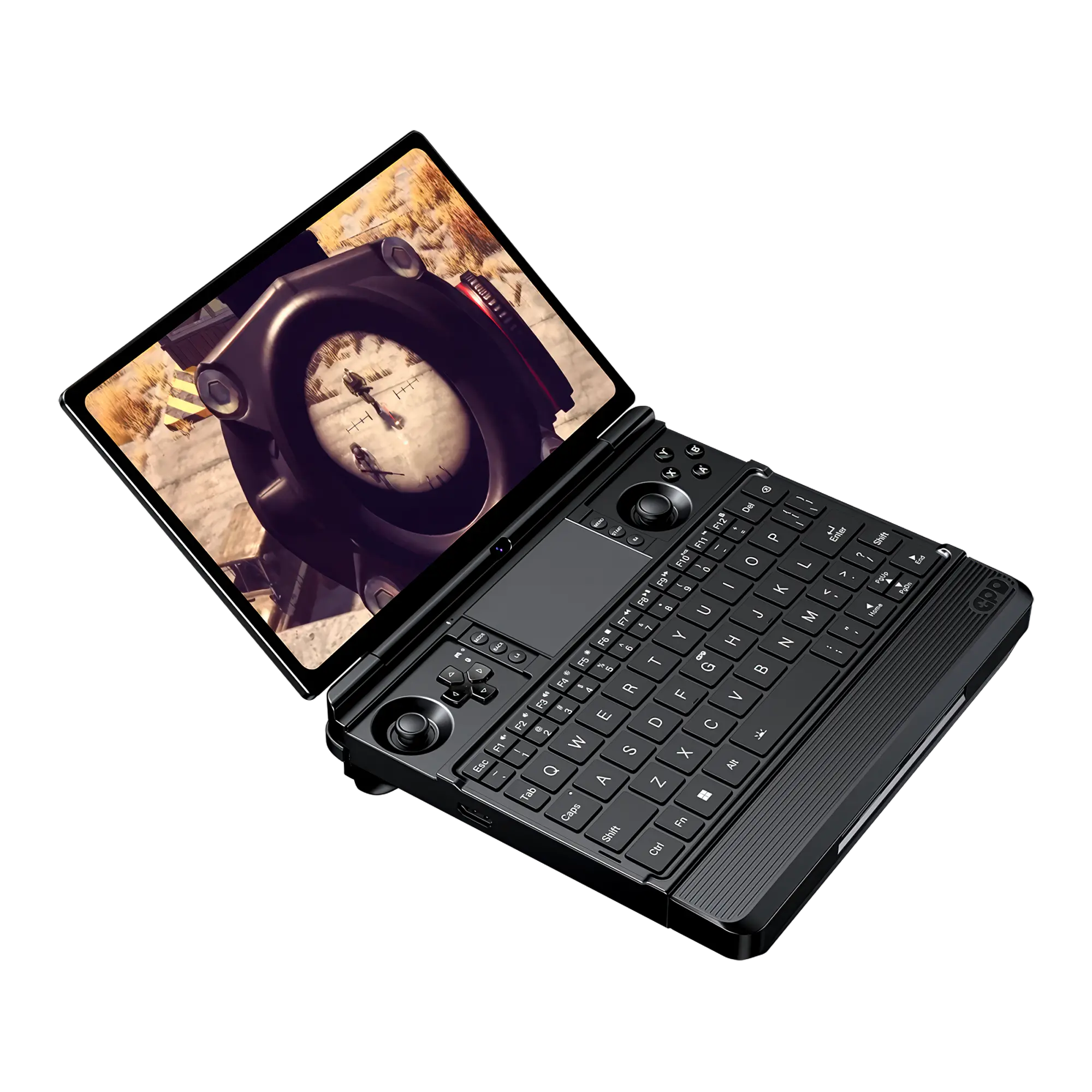
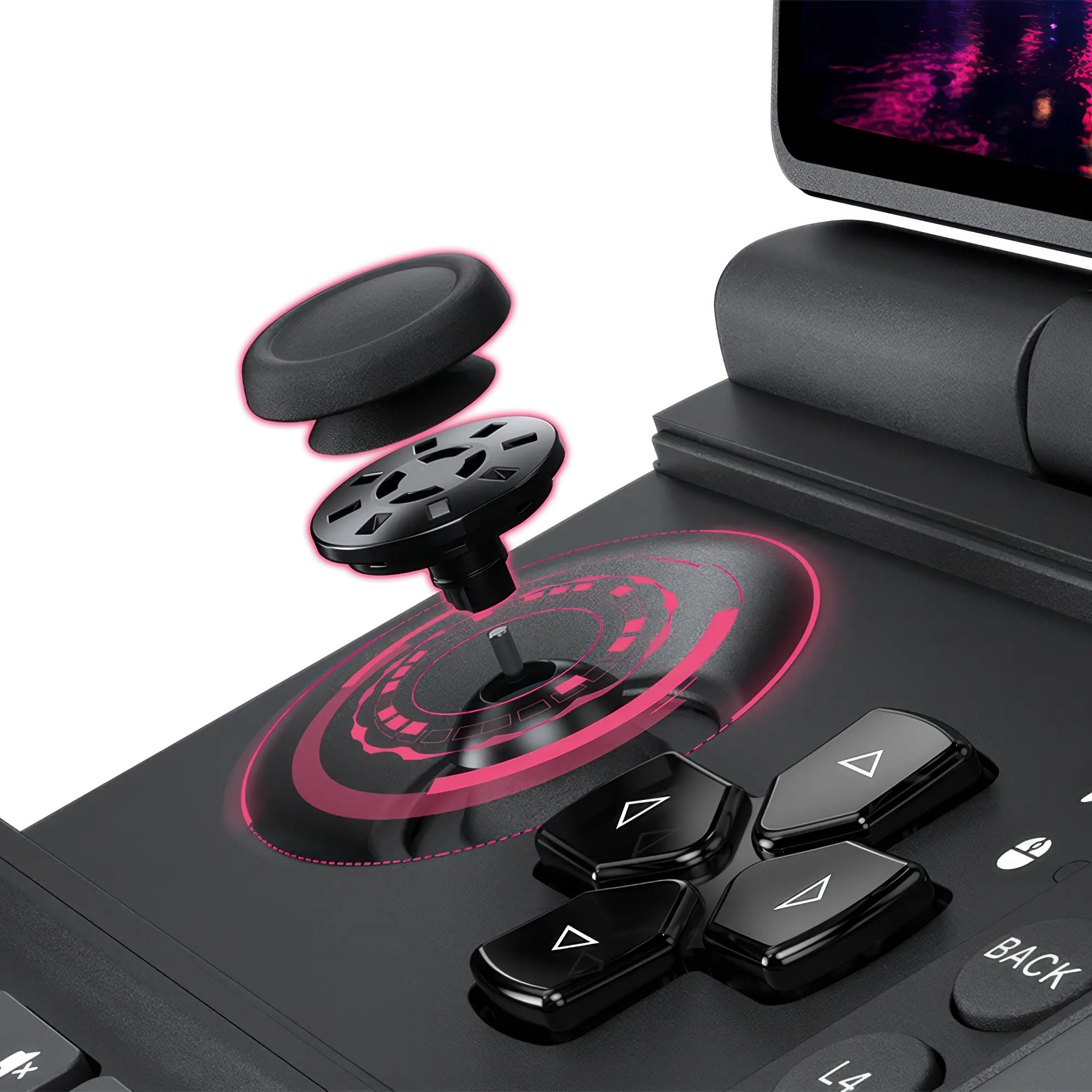
In addition to the keyboard and touchpad, the WIN Max 3 has a complete set of integrated gaming controls: two capacitive mini joysticks, a D-pad, ABXY buttons, shoulder buttons and analogue Hall-effect triggers.
There are also programmable L4/R4 buttons, a six-axis motion sensor and dual linear vibration motors. GPD advertises joystick sampling rates of up to 8000Hz.
Magnetic covers can hide the gaming controls when you're using the device for work. A backlit QWERTY keyboard, integrated touchpad and fingerprint sensor in the power button round out the controls.
Removable battery and modular cooling
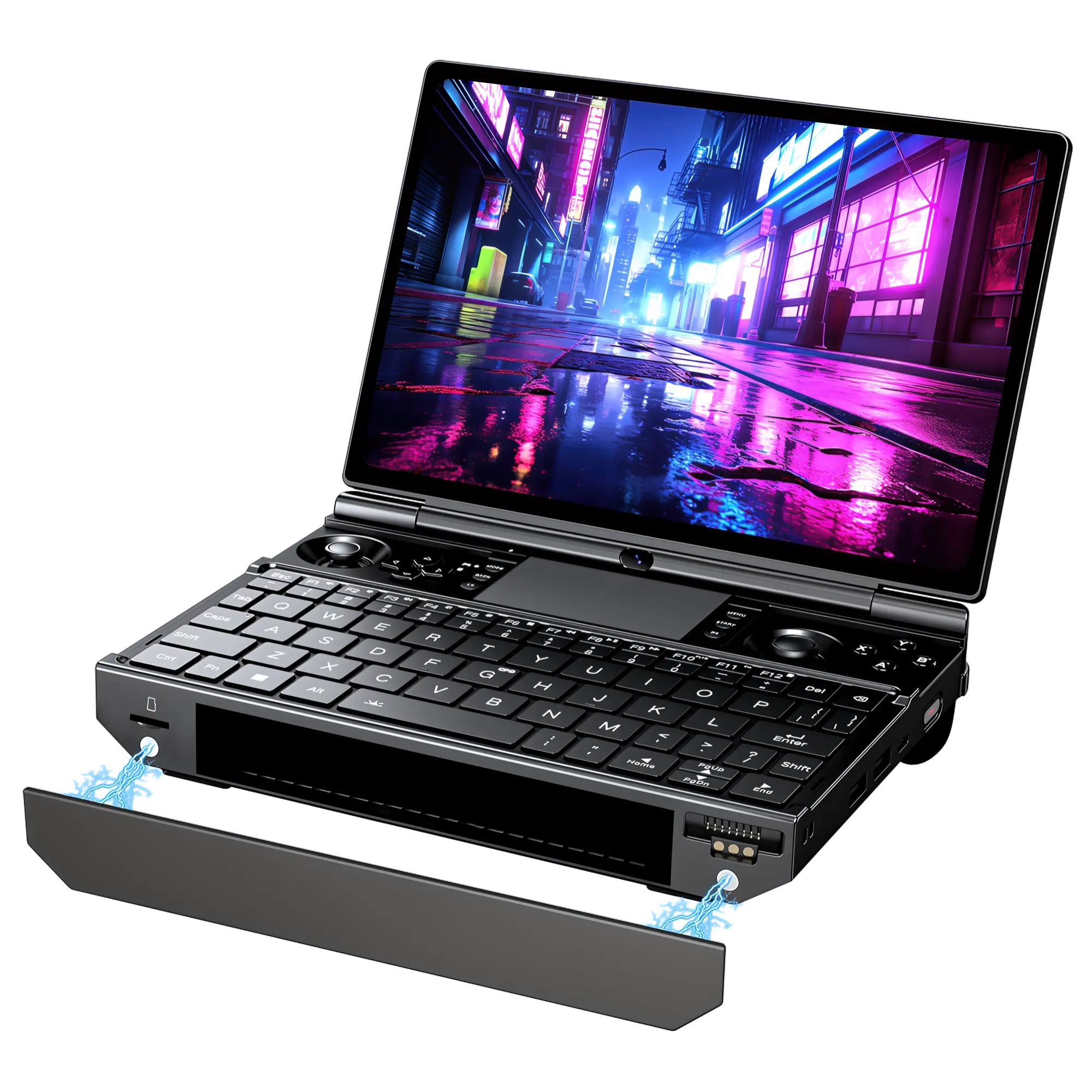
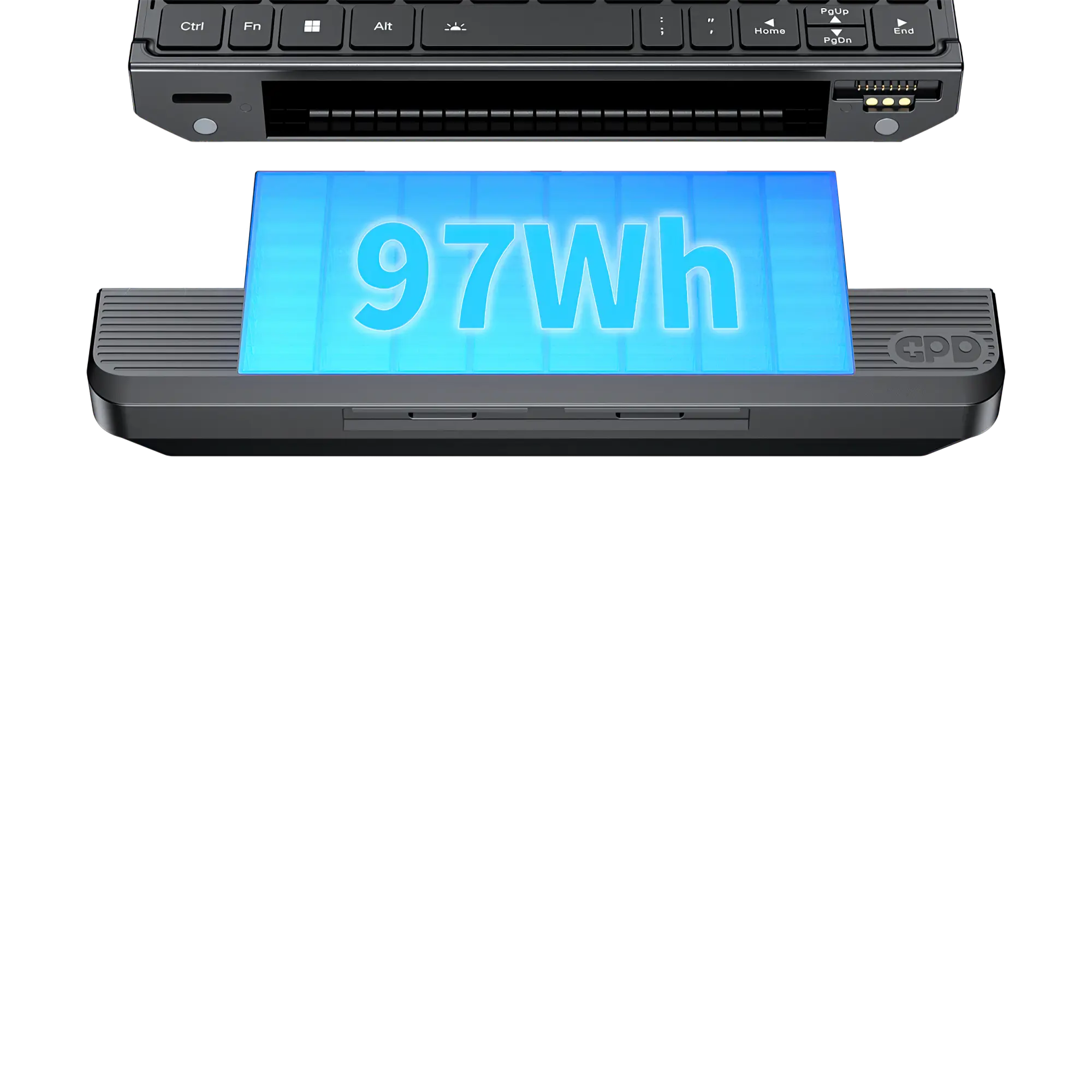
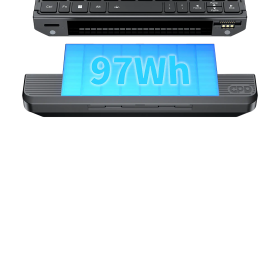
One of the WIN Max 3's distinctive features is its removable external 97Wh battery module. It attaches magnetically and is included in the package. The computer can also run directly from its power adapter without the battery connected.
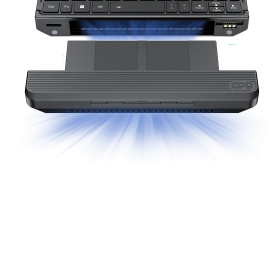
An optional external fan module can replace the battery module when you need additional cooling for sustained demanding workloads. The extra fan module is not included in the standard package.
A 180W DC power adapter is included. The USB4 port also supports USB Power Delivery up to 100W. For maximum performance, the dedicated power adapter is recommended.
At 207 × 147 × 34mm and approximately 815g without attachments, the WIN Max 3 is compact but certainly not pocket-sized. With the battery connected, it measures approximately 207 × 180 × 34mm and weighs around 1220g.
Battery life depends heavily on workload, display brightness, refresh rate and performance settings. Heavy gaming at high power limits will drain the battery much faster than lighter productivity tasks.
Connectivity and external graphics
The WIN Max 3 includes a USB4 Type-C port supporting up to 40Gbps, DisplayPort 2.1 and 100W Power Delivery, alongside a second USB-C 3.2 Gen 2 port supporting up to 10Gbps and video output.
Two USB-A 3.2 Gen 2 ports, HDMI 2.1, microSD Express and a combined 3.5mm headphone/microphone jack cover everyday connectivity. Wi-Fi 6E and Bluetooth 5.3 provide wireless connections.
Compatible external GPUs can be connected through USB4, giving you additional graphics options for desktop use. Unlike the WIN Max 2, however, the WIN Max 3 does not include a separate OCuLink port.
A laptop for more than just games
Windows 11 Home, a built-in 5MP ultra-wide camera, microphone and stereo speakers with DTS:X Ultra support make this a practical portable PC for work as well as gaming.
With its keyboard, touchpad, touchscreen and external monitor connectivity, the WIN Max 3 is equally suited to office tasks, video calls, software development, content creation and compact desktop setups.
What's included?
- GPD WIN Max 3 in your selected configuration
- Removable external 97Wh battery module
- 180W DC power adapter and power cable
- User manual
- Warranty card
Note: The external fan module, stylus, eGPU and additional SSDs are sold separately.

- System
- Windows PC
- Processor
- AMD Ryzen™ AI Max+ 388
AMD Ryzen™ AI Max+ 395 - Graphics processor
- AMD Radeon 8060S
- Display diagonal
- 9.06
- Display resolution
- 2400 × 1504
- Touchscreen
- Yes
- Ports
- 2x USB-A 3.2 Gen 2
3.5mm Headset
HDMI 2.1
microSD Express
USB-C 3.2 Gen 2
USB4 - Special features
- Fingerprint-Reader
Gaming Controls
Gyroscope
Microphone
Microsoft Precision Touchpad
Stylus support
Vibration
Webcam - Device weight (g)
- 815
- Camera resolution
- 2592 × 1944
- Battery capacity (Wh)
- 97
- Device dimensions (W × H × D)
- 207 × 147 × 34 mm (ohne Module)
- Storage interface
- PCIe 4.0
- Storage protocol
- NVMe
- Storage type
- SSD
- Storage form factor
- M.2 2230
M.2 2280 - Wi-Fi
- Wi-Fi 6E
- Bluetooth
- Bluetooth 5.3
- Keyboard backlight
- Backlit
- Memory (GB)
- 128
32
64 - Memory type
- LPDDR5X
- Memory speed (MT/s)
- 8000
- Memory channel mode
- Quad Channel
- Panel technology
- AMOLED
- Display glass
- Corning Gorilla Glass 6
- Refresh rate (Hz)
- 165
- Operating system family
- Windows
- Operating system version
- Windows 11
- Multi-touch
- Yes
- Number of analog sticks
- 2
- Stick technology
- Capacitive
- Trigger technology
- Linear Hall effect
- Vibration
- Yes
Practical answers about compatibility, features and how things work.
What are Hall effect and TMR sticks, and how do conventional analog sticks work?
Modern controllers are often advertised as having Hall effect or TMR sticks. Both technologies aim to provide precise, long-lasting analog sticks. How do they differ from conventional designs?
Conventional analog sticks: potentiometers
Traditional analog sticks use potentiometers, in which a small electrical wiper moves along a resistive track.
The resulting change in electrical resistance is measured to determine the stick's position. Typically, two potentiometers are used to measure horizontal and vertical movement.
The drawback is that the resistive tracks can wear over time due to mechanical contact. Dust and dirt can also interfere with the measurement. One possible result is stick drift: the controller registers movement even though the stick is not being touched.
Hall effect sticks: magnetic sensing without electrical contact
Hall effect sticks use magnets and specialized sensors to determine the position of the analog stick.
They measure changes in a magnetic field, so they do not require the electrical wiper contact used by conventional potentiometers.
This removes a common source of wear. Hall effect sticks are therefore much less susceptible to stick drift caused by worn potentiometer contacts.
TMR sticks: a different magnetic sensor technology
TMR stands for Tunnel Magnetoresistance.
Like Hall effect sticks, TMR sticks sense their position without electrical contact, using magnets. However, the measurement principle is different: the sensors detect changes in electrical resistance caused by the magnetic field.
TMR sensors can be particularly sensitive to small changes and, depending on their design, may consume less power than comparable Hall sensors.
That does not automatically mean every TMR controller is more precise or has better battery life. The electronics, calibration and processing of the sensor readings matter as well.
Are Hall effect and TMR sticks completely immune to stick drift?
No. Both technologies avoid wear of the conventional electrical wiper contacts, but the sticks still contain mechanical components.
For example, return springs can wear, dirt can obstruct movement, and calibration problems can occur. Hall effect and TMR sticks can therefore still report unintended movement.
However, the risk of classic stick drift caused by worn potentiometer tracks is significantly reduced.
How do the triggers (shoulder buttons) work?
Analog triggers, such as LT/RT or L2/R2, can use similar sensing methods:
- Potentiometer triggers: Trigger position is measured through a change in electrical resistance.
- Hall effect triggers: Position is measured without electrical contact, using a magnetic field. This eliminates wear from an electrical wiper contact.
- Digital triggers: These work like regular buttons and detect only whether they are pressed. They do not measure a continuously variable position.
Analog triggers are useful in racing games, for example, because they allow fine control over acceleration and braking. Digital triggers can be useful in games that only need a quick button press.
Which technology is best?
Well-designed Hall effect and TMR sticks offer clear advantages over conventional potentiometers in terms of sensor wear.
TMR may also offer benefits in sensitivity and power consumption. However, a well-designed Hall effect stick can perform just as well as, or better than, a poorly designed TMR stick.
Besides the sensor technology, the mechanics, calibration and overall quality of the controller are equally important.
Manufacturer
EU responsible person

GPD Duo Replacement Battery

GPD Win Mini (2023/2024 version) Replacement Battery
Capacity: 3,810 mAh / 44.24 Wh
Voltage: 11.61 V (3 cells, Li-Polymer)
Compatible with: GPD Win Mini 2023 & 2024
Part number: 4139D5
Original GPD manufacturer

GPD Win 5 - Official Carry Case

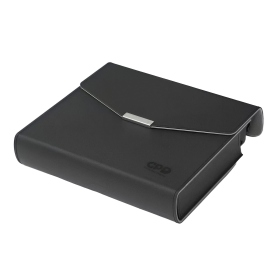
GPD Pocket 3 / 4 - Official Carry Case
Official GPD accessory, tailored for GPD Pocket 4 (also compatible with Pocket 3)
Faux leather exterior with soft inner lining
Magnetic closure for quick and secure access
Stylus pocket included (note: GPD stylus is too long to close case fully)
Slim, lightweight design – no unnecessary bulk

GPD MicroPC 2 - Official Carry Case
Hard EVA shell: rigid, shock-absorbing protection
Precision fit for the GPD Micro PC 2 (device only, no charger included)
Official Micro PC 2 imprint on the case
Soft interior lining prevents scratches
All-around zipper for secure closure
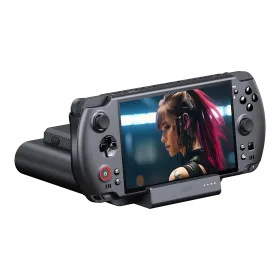
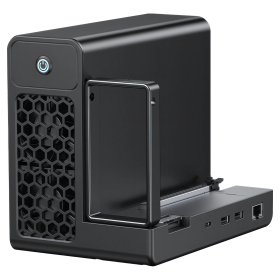
GPD Win 5 Dock

GPD Pocket 4 RS-232 Module

GPD Pocket 4 KVM (Capture)-Module

GPD Win Mini Carry Case (pre-2025er edition)

GPD Win Max 2 - Replacement keyboard (QWERTY)

GPD Win Max 2 - German replacement keyboard (QWERTZ)
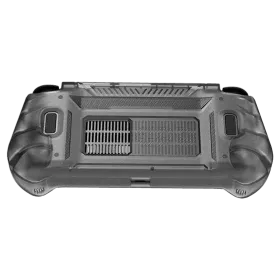
GPD Win 3 Grips
Custom-molded to fit the GPD Win 3 precisely
Non-slip surface provides secure grip during gameplay
Protects against scratches, bumps and daily wear
Enhances ergonomics for marathon gaming sessions
Full access to all ports, buttons and controls
Quick installation with residue-free removal