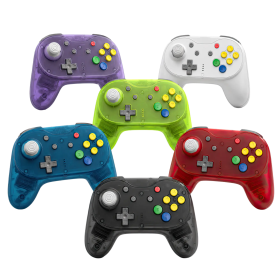
Striker DC Wireless Controller for Dreamcast
zoom_out_map
Sold items

This item has been sold

351
times
Striker DC Wireless Controller for Dreamcast
Striker DC Wireless Controller for Dreamcast Striker DC Wireless Controller for Dreamcast Striker DC Wireless Controller for Dreamcast Striker DC Wireless Controller for Dreamcast Striker DC Wireless Controller for Dreamcast Striker DC Wireless Controller for Dreamcast
Out-of-Stock

Striker DC Wireless Controller (Dreamcast)

Experience the Sega Dreamcast like never before with the Striker DC Wireless Controller from Retro Fighters.

  • 2.4 GHz wireless connection with 30-foot range for freedom of movement
  • Hall-effect analog sticks prevent drift for precision gaming
  • Wireless vibration feedback without additional packs required
  • VMU wireless dongle for full compatibility with memory cards
  • USB-C rechargeable battery with 10+ hours of playtime
  • Ergonomic design with both digital and analog triggers

€55.00 Tax included (22%)

Out-of-Stock

Color

Color:

Sold items

This item has been sold

351
times

Cut the cord and rediscover your Dreamcast collection wirelessly

The Striker DC Wireless Controller from Retro Fighters brings modern gaming comfort to your beloved Sega Dreamcast. This isn't just another retro controller—it's a complete reimagining of what Dreamcast gaming can be. With cutting-edge wireless technology and thoughtful design improvements, you'll wonder how you ever played with a wired controller.

True Wireless Freedom

Say goodbye to tangled cables and limited movement. The Striker DC uses reliable 2.4 GHz wireless technology to give you a lag-free connection up to 30 feet away from your console. Whether you're settling in for a marathon session of Shenmue or battling it out in Power Stone, you'll enjoy the freedom to play from anywhere in the room. The included wireless dongle connects directly to your Dreamcast controller port, and best of all, it's fully compatible with all first-party VMUs, so you never have to choose between wireless gaming and saving your progress.

Built to Last with Hall-Effect Technology

One of the most frustrating issues with modern controllers is analog stick drift, but the Striker DC eliminates this problem entirely. Featuring next-generation hall-effect analog sticks, this controller uses magnetic sensors instead of traditional potentiometers. The result? No drift, ever. Your precise inputs today will be just as accurate years from now, making this controller a long-term investment in your gaming setup.

Comfort Meets Performance

Retro Fighters designed the Striker DC with extended gaming sessions in mind. The ergonomic layout fits naturally in your hands, while the responsive D-pad ensures accuracy in fighting games and platformers. You get the best of both worlds with digital shoulder buttons and analog pressure-sensitive triggers, adapting perfectly to any game in your collection. The built-in turbo functionality adds even more versatility for those intense shooter sessions.

Feel Every Moment

Here's something special: wireless vibration feedback without the need for bulky vibration packs. The Striker DC delivers rumble effects directly through the controller, letting you feel every explosion, crash, and impact without any additional hardware. Combined with the USB-C rechargeable battery that delivers over 10 hours of gameplay per charge, you've got everything you need for the ultimate wireless Dreamcast experience. And with updateable firmware, your controller will continue to improve over time.

RF-StrikerWL-WHT
0850046080173
System
Sega Dreamcast
Controller type
Gamepad
Brand compatibility
Sega
Battery category
Secondary, 1-50g
WEEE registration number
23582226
Battery weight (g)
40
Controller connector
Sega Dreamcast
Connection type
2.4 GHz wireless
Number of analog sticks
1
Connection compatibility
2.4 GHz wireless
Stick technology
Hall effect
Trigger technology
Mixed digital/analog
Vibration
Yes
Extra/back buttons
Turbo
Input mode switching
StrikerDC Wireless: 2.4G radio via dedicated Dreamcast/VMU receiver. USB-C is for charging and firmware updates. No confirmed Windows USB, Bluetooth, XInput or DInput modes.
DRAGONBOX KNOW-HOW

Practical answers about compatibility, features and how things work.

What is the difference between 2.4 GHz wireless and Bluetooth controllers?

Both types of connection are wireless and use the 2.4 GHz frequency band. The difference is the transmission technology: Bluetooth is a widely used standard, whereas “2.4 GHz wireless” usually refers to a manufacturer's own radio link with a matching receiver.

Bluetooth: flexible and widely compatible

Many PCs, gaming handhelds, smartphones, tablets and consoles support Bluetooth controllers. If the controller is compatible with the device, you usually pair it once through the Bluetooth settings. After that, it will normally reconnect automatically.

No additional receiver is needed, leaving a USB port free.

However, not every Bluetooth-enabled device supports every Bluetooth controller. Game consoles in particular may require certain controller models or input modes.

2.4 GHz wireless: plug in and play

Controllers using 2.4 GHz wireless usually come with a matching USB receiver (dongle). Plug it in and switch the controller on. The two are often paired already.

This offers several advantages:

  • No Bluetooth menu or Bluetooth manager setup is needed.
  • It also works with compatible devices that have no built-in Bluetooth.
  • Many systems recognize the receiver as a regular USB controller.
  • That can be particularly useful for PCs, retro systems and other devices with USB ports.

The device must still support the particular receiver and its input mode. Not every dongle automatically works with every system. Some retro controllers also use dedicated receivers for particular consoles.

What about speed?

Many 2.4 GHz controllers offer high polling rates and low, consistent latency. Modern Bluetooth controllers can also be very fast, however. Actual performance depends on the specific controller and connection.

Which connection should I choose?

Bluetooth is especially useful if you want to use a controller with different compatible devices without carrying an extra receiver.

2.4 GHz wireless is often a good choice if you want a straightforward setup, prefer a responsive connection, or use a device without Bluetooth.

Check the product's technical specifications to see which connections and systems it supports.

What do polling rate and latency mean for a controller?

Polling rate and latency both affect how quickly a controller responds to your inputs, but they describe two different things.

What is polling rate?

Polling rate describes how often the controller or its connection reports or requests new input data from the system.

It is measured in hertz (Hz).

Polling rateReporting interval
125 Hz8 milliseconds
250 Hz4 milliseconds
500 Hz2 milliseconds
1,000 Hz1 millisecond

The higher the polling rate, the shorter the interval between input reports can be.

A high polling rate can therefore be useful in fast-paced games. The connected system must also support the relevant reporting rate.

What is latency?

Latency is the delay between an action on the controller and the moment the system registers that input.

Several factors contribute to this delay:

  • How quickly the controller detects and processes the button press.
  • How long transmission via cable, Bluetooth or 2.4 GHz wireless takes.
  • How quickly the connected system processes the input.

Before the action becomes visible on the screen, the game and display introduce additional processing delays.

Does a 1,000 Hz polling rate automatically mean 1 ms of latency?

No. At 1,000 Hz, only the reporting interval is one millisecond. The total input delay can be considerably higher.

In practice, a well-optimized controller running at 500 Hz can therefore respond faster than a poorly optimized controller running at 1,000 Hz.

Which values matter?

For most games, consistently low latency matters more than the highest possible polling rate.

Low delays can be especially beneficial for fast action games, shooters and competitive games. In retro games, processing by emulators, consoles or FPGA systems and the display also matter.

Our tip: A high polling rate is an interesting technical specification, but does not by itself prove that a controller is fast. Measurements of real-world latency under comparable conditions are more meaningful.

What are Hall effect and TMR sticks, and how do conventional analog sticks work?

Modern controllers are often advertised as having Hall effect or TMR sticks. Both technologies aim to provide precise, long-lasting analog sticks. How do they differ from conventional designs?

Conventional analog sticks: potentiometers

Traditional analog sticks use potentiometers, in which a small electrical wiper moves along a resistive track.

The resulting change in electrical resistance is measured to determine the stick's position. Typically, two potentiometers are used to measure horizontal and vertical movement.

The drawback is that the resistive tracks can wear over time due to mechanical contact. Dust and dirt can also interfere with the measurement. One possible result is stick drift: the controller registers movement even though the stick is not being touched.

Hall effect sticks: magnetic sensing without electrical contact

Hall effect sticks use magnets and specialized sensors to determine the position of the analog stick.

They measure changes in a magnetic field, so they do not require the electrical wiper contact used by conventional potentiometers.

This removes a common source of wear. Hall effect sticks are therefore much less susceptible to stick drift caused by worn potentiometer contacts.

TMR sticks: a different magnetic sensor technology

TMR stands for Tunnel Magnetoresistance.

Like Hall effect sticks, TMR sticks sense their position without electrical contact, using magnets. However, the measurement principle is different: the sensors detect changes in electrical resistance caused by the magnetic field.

TMR sensors can be particularly sensitive to small changes and, depending on their design, may consume less power than comparable Hall sensors.

That does not automatically mean every TMR controller is more precise or has better battery life. The electronics, calibration and processing of the sensor readings matter as well.

Are Hall effect and TMR sticks completely immune to stick drift?

No. Both technologies avoid wear of the conventional electrical wiper contacts, but the sticks still contain mechanical components.

For example, return springs can wear, dirt can obstruct movement, and calibration problems can occur. Hall effect and TMR sticks can therefore still report unintended movement.

However, the risk of classic stick drift caused by worn potentiometer tracks is significantly reduced.

How do the triggers (shoulder buttons) work?

Analog triggers, such as LT/RT or L2/R2, can use similar sensing methods:

  • Potentiometer triggers: Trigger position is measured through a change in electrical resistance.
  • Hall effect triggers: Position is measured without electrical contact, using a magnetic field. This eliminates wear from an electrical wiper contact.
  • Digital triggers: These work like regular buttons and detect only whether they are pressed. They do not measure a continuously variable position.

Analog triggers are useful in racing games, for example, because they allow fine control over acceleration and braking. Digital triggers can be useful in games that only need a quick button press.

Which technology is best?

Well-designed Hall effect and TMR sticks offer clear advantages over conventional potentiometers in terms of sensor wear.

TMR may also offer benefits in sensitivity and power consumption. However, a well-designed Hall effect stick can perform just as well as, or better than, a poorly designed TMR stick.

Besides the sensor technology, the mechanics, calibration and overall quality of the controller are equally important.

Manufacturer
Retro Fighters
21818 Lassen St Ste A
Suite A
91311 Chatsworth, CA
United States
EU responsible person
OpenPandora GmbH
+49 841 1317733
Asternweg 5
Michael Mrozek
85080 Gaimersheim
Germany
chat Comments (0)
Striker DC Wireless Controller (Dreamcast)
€55.00