Wired Controllers
This section contains wired controllers, joysticks, fight sticks and specialist input devices for classic consoles, modern systems and PC.
Check the connector, button layout and supported platform. With 9-pin joysticks, USB devices and arcade controllers, the exact connection determines where the device works.
There are 28 products.
Immortal Joystick v2 (DB9)
Robust diecast aluminium construction with premium Sanwa and Seimitsu arcade parts
Detachable braided cable for easy replacement and maintenance
Autofire function and switchable second button for jump functionality
Available in left-handed (arcade style) or right-handed (home computer style) layouts
Compatible with Amiga, C64, Atari, ZX Spectrum, Sega Master System and more
Customizable with standard arcade parts – swap buttons and ball tops to your preference
8BitDo Ultimate 2C Wired Controller (PC, Android)
Hall effect sticks and triggers for exceptional precision and durability
1000Hz polling rate for lightning-fast responsiveness
Four shoulder buttons (L1/R1/L4/R4) plus rumble feature
Compatible with Windows PC and Android devices
Customizable button mapping via dedicated software
USB-C wired connection for zero-latency gaming
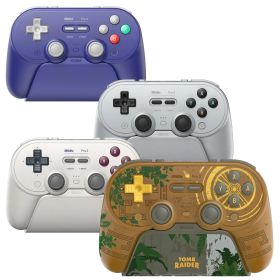
8BitDo Pro 3 Controller (Switch, PC, Steam Deck, Android, iOS, macOS)
Three connection modes: Bluetooth, 2.4G wireless adapter, and wired USB for maximum compatibility
Premium TMR joysticks and Hall Effect triggers for drift-free precision and durability
Unique swappable magnetic ABXY buttons let you physically rearrange your button layout
Compatible with Switch 1 & 2, Windows PC, Apple devices, SteamOS, and Android
Includes charging dock, 2.4G adapter, ball-top joystick caps, and button puller tool
Pro back paddle buttons (L4/R4) and 1000mAh rechargeable battery for extended gaming sessions
FightBox Trackball R6 (PC)
Retro-Bit SEGA Mega Drive 6-button Arcade Pad (Crimson Red, 9-Pin)
Official SEGA licensed arcade pad with classic 6-button layout
Compatible with all original Mega Drive and Genesis console models
Extended 3-meter cable for comfortable couch gaming
Original 9-pin connector for authentic retro experience
Premium build quality matching original controller standards
Perfect for classic fighting games and 16-bit titles
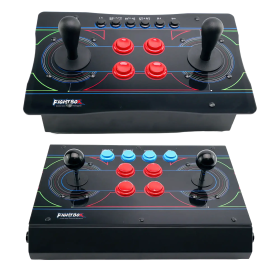
FightBox Twin Stick R10 (PC/PS3/PS4/NSW)
Two full-sized arcade joysticks for authentic twin-stick gameplay
Sanwa or HAPP sticks selectable (check product variant)
Metal case with transparent acrylic panel
GP2040-CE firmware on Raspberry Pi Pico – zero delay
Compatible with PC, PS3, PS4 & Nintendo Switch
FightBox Arcadestick R10 (PC / PS3 / NSW)
Premium Sanwa arcade stick with BAOLIAN buttons for tournament-quality precision
LED-illuminated 3" trackball for authentic retro gaming (PC compatible)
Compatible with PC, PS3, and Nintendo Switch via 3m USB cable
Durable metal case with acrylic panel and rubber feet for stable gameplay
Zero Delay RP2040 controller board with GP2040-CE firmware
Side buttons for pinball controls plus Insert Coin and Start buttons
FightBox M8 CrossUp Fightstick (PS5 / PS4 / NSW / NSW 2 / PC)
Hybrid design: classic joystick plus 4 directional buttons for faster inputs
Premium Sanwa OBSF-30 buttons and choice of Japanese or Korean lever
Brook Gen-5 Fighting Board with full PS5/PS4/Switch 2/Switch/PC compatibility
Durable metal case with black matte acrylic panel and 3m USB cable
SOCD cleaning, turbo function, and web configurator support
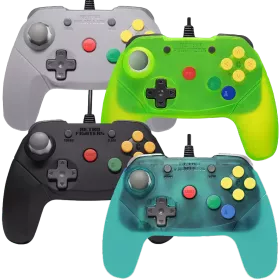
Brawler64 v2 (Wired)
Next-generation ergonomic gamepad design for comfortable N64 gaming
Responsive analog stick and dual Z-triggers for improved control
Ultra-fast turbo function that can be toggled on or off
Compatible with Rumble and Memory Paks
Extra-long 10-foot cable for flexible play positions
Updated v2 version with enhanced features
"Specialist" Controller (TurboGrafx-16®/ PC Engine™)
FightBox R2 Arcadestick (SNK NeoGeo MVS / AES / CD)
Frequently asked questions
Practical answers about compatibility, features and how things work.
What input modes are available: XInput, DInput, Switch and PlayStation?
XInput is the best choice for most PC gamers. This widely supported input mode follows the Xbox controller layout and is recognized directly by many modern Windows games. For most users, that is all they need. However, XInput support does not automatically mean a controller works on a real Xbox console.
DInput (DirectInput) is the older Windows standard. Some older PC games, such as Crimson Skies or Need for Speed: Underground 2, support DirectInput but not native XInput.
An additional DInput or generic USB HID mode can also be useful for retro gaming systems, FPGA devices, emulators and other specialized setups. Some devices support Xbox-compatible controllers, while others expect a standard USB HID gamepad. Which input modes work depends on the specific device and its software.
For example, MiSTer FPGA supports many USB controllers as well as Xbox-compatible input devices. Depending on the core, different button mappings or special input features may be required. DInput itself is therefore not a general requirement on MiSTer.
If you plan to use your controller with retro or FPGA systems, check which input modes are supported beforehand. A controller with several selectable modes offers more flexibility.
Switch mode makes the controller appear to compatible devices as a Nintendo Switch Pro Controller. It can be useful beyond the Switch: Steam Input, Linux and various applications can also support these controllers. However, not every PC game will recognize this mode automatically.
PlayStation mode can refer to different compatibility modes depending on the controller, such as PS4 controller or PlayStation Classic modes. There is no single universal PlayStation mode. Compatibility with a particular PlayStation console must be explicitly confirmed for the product.
Connection type matters: Not every input mode is available over every connection. Some controllers support DInput only via a USB cable, while others also offer it through a 2.4 GHz receiver or Bluetooth.
That is why our technical specifications list confirmed input modes separately for USB, 2.4 GHz and Bluetooth.
What do polling rate and latency mean for a controller?
Polling rate and latency both affect how quickly a controller responds to your inputs, but they describe two different things.
What is polling rate?
Polling rate describes how often the controller or its connection reports or requests new input data from the system.
It is measured in hertz (Hz).
| Polling rate | Reporting interval |
|---|---|
| 125 Hz | 8 milliseconds |
| 250 Hz | 4 milliseconds |
| 500 Hz | 2 milliseconds |
| 1,000 Hz | 1 millisecond |
The higher the polling rate, the shorter the interval between input reports can be.
A high polling rate can therefore be useful in fast-paced games. The connected system must also support the relevant reporting rate.
What is latency?
Latency is the delay between an action on the controller and the moment the system registers that input.
Several factors contribute to this delay:
- How quickly the controller detects and processes the button press.
- How long transmission via cable, Bluetooth or 2.4 GHz wireless takes.
- How quickly the connected system processes the input.
Before the action becomes visible on the screen, the game and display introduce additional processing delays.
Does a 1,000 Hz polling rate automatically mean 1 ms of latency?
No. At 1,000 Hz, only the reporting interval is one millisecond. The total input delay can be considerably higher.
In practice, a well-optimized controller running at 500 Hz can therefore respond faster than a poorly optimized controller running at 1,000 Hz.
Which values matter?
For most games, consistently low latency matters more than the highest possible polling rate.
Low delays can be especially beneficial for fast action games, shooters and competitive games. In retro games, processing by emulators, consoles or FPGA systems and the display also matter.
Our tip: A high polling rate is an interesting technical specification, but does not by itself prove that a controller is fast. Measurements of real-world latency under comparable conditions are more meaningful.
Can I remap controller buttons or use macros and turbo functions?
That depends on the controller. Remapping, macros and turbo are different features. Not every controller supports all of them, and some settings are available only through specific software, connection types or input modes.
- Remapping: One button takes over the function of another, such as swapping A and B. Depending on the model, button mappings can be changed on the controller or in an app, sometimes with saved profiles.
- Macros: A single press triggers several inputs at once or in a sequence. Support for button sequences, timing and custom combinations varies by controller. Remappable buttons do not automatically mean macro support.
- Turbo: A button sends repeated presses without the player having to press it over and over. Some controllers repeat only while the button is held; others also offer continuous automatic repetition.
- Keyboard input: Some controllers or configuration apps can map controller buttons to keyboard commands. This is useful for PC games with functions that are accessible only through keyboard keys. Keyboard mapping is not an inherent feature of macros.
Important: Extra buttons do not necessarily support programmable macros. Some can only duplicate existing controller buttons. Software availability, profiles and stored settings also vary by model and platform.
Check the technical specifications and, where available, the FAQs on the individual product page for functions confirmed for that particular controller. Online games may also have their own rules regarding macros or turbo functions.
Why does my controller work on a PC but not necessarily on Xbox or PlayStation?
A controller that works on Windows is not automatically compatible with an Xbox or PlayStation console. PC input modes and compatibility with a real console are two different things.
XInput is a widely supported Windows game input standard based on Xbox-style controllers. A gamepad may operate as an XInput device on a PC without being recognized as an authorized controller by a physical Xbox console. DInput or generic USB gamepad support does not guarantee console compatibility either.
Xbox and PlayStation: Supported controllers depend on the console generation, the connection protocol and the devices accepted or authorized by the system. Compatibility with an older console does not automatically extend to the next generation or to every game.
Adapters and receivers: Some controllers require a receiver or adapter specifically intended for the target console. An ordinary Bluetooth or 2.4 GHz USB receiver designed for PCs will not necessarily work on consoles. The available input modes may also differ between USB, Bluetooth and 2.4 GHz connections.
Nintendo Switch and Steam: A Switch- or Steam-compatible input mode does not itself establish Xbox or PlayStation support. Likewise, PC software may recognize controllers that a particular console game cannot use directly.
What matters is the explicitly confirmed platform support of the specific controller. Check the compatibility list and technical specifications on its product page rather than relying on labels such as “XInput”, “Bluetooth” or “for PC”. If a console is not listed, do not assume that it is supported.